Deciding between breast augmentation and a breast lift can feel overwhelming, especially when both procedures are designed to enhance the appearance of the breasts but address different concerns. Whether you’ve experienced changes after pregnancy, weight loss, aging, or simply want to improve your natural shape, understanding your options is the first step toward making a confident decision.
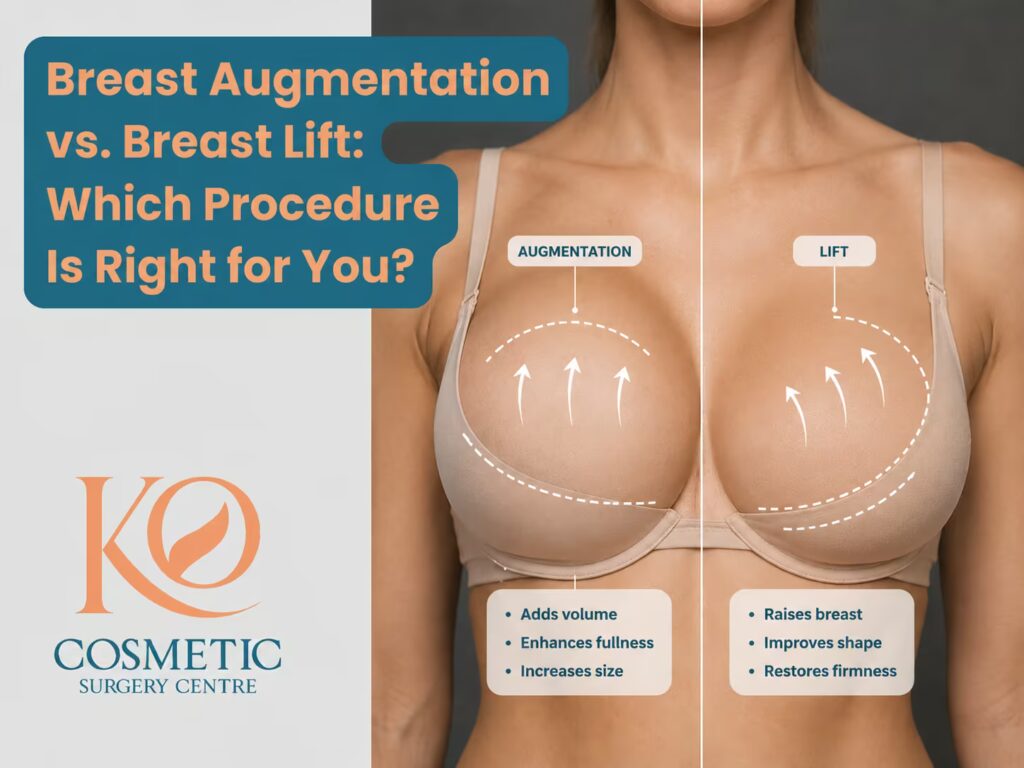
Breast augmentation focuses on increasing breast size and restoring lost volume using implants, making it an excellent choice for women who want fuller, more proportionate breasts. A breast lift, also known as mastopexy, is designed to raise and reshape sagging breasts by removing excess skin and repositioning the breast tissue and nipples for a more youthful appearance.
While both procedures can significantly improve confidence and body image, the right choice depends on your personal goals, breast anatomy, and the results you hope to achieve. In this guide, we’ll explain the differences between breast augmentation and breast lift surgery, compare their benefits, and help you determine which procedure may be the best fit for you.
Understanding Breast Augmentation
Breast augmentation (augmentation mammoplasty) enlarges the breasts, usually by placing implants under the breast tissue or chest muscle. Surgeons use silicone or saline breast augmentation with implant techniques to add volume. This procedure is ideal for women who feel their breasts are too small, asymmetrical, or have lost fullness after pregnancy or weight loss. During surgery, an implant is placed through a small incision (often under the breast crease, around the areola, or in the armpit). Modern implants come in many sizes and shapes to create the look you want.
Who Is It Generally Suitable For?
Breast augmentation may be considered by women who:
- Have naturally small or underdeveloped breasts relative to their frame
- Have experienced a noticeable loss of breast volume after pregnancy, breastfeeding, or weight loss
- Have one breast that is significantly smaller than the other (asymmetry)
- Have completed breast development — most surgeons in India require patients to be at least 18 years of age
How Is It Performed?
The procedure is carried out under general anaesthesia. The surgeon makes a small incision — commonly beneath the breast crease, around the edge of the areola, or in the armpit — and creates a space either behind the breast tissue or beneath the chest muscle. The implant is then positioned and the incision is closed. The type of implant, its size and shape, and the incision placement are decided during the pre-operative consultation based on your anatomy and goals.
Recovery — What to Generally Expect
Most patients can return to desk-based work within one to two weeks. Strenuous physical activity, lifting, and overhead movements are typically avoided for four to six weeks. A surgical support bra is usually worn during the initial recovery period. Swelling and tenderness are common in the first few weeks and gradually reduce. Every patient heals differently — your surgeon will give you a personalised recovery plan.
Understanding Breast Lift (Mastopexy)
A breast lift raises and reshapes sagging breasts. Unlike augmentation, a lift does not significantly change breast volume; instead, it removes excess skin and tightens the surrounding tissue to create a perkier shape. It’s ideal for women whose breasts have begun to droop (often due to pregnancy, breastfeeding, aging, or weight changes). In a lift procedure, the surgeon repositions the nipple higher on the breast and may also reduce the size of the areola if needed.
Who Is It Generally Suitable For?
A breast lift may be appropriate for women who:
- Have breasts with adequate volume but noticeable sagging (ptosis)
- Have nipples that point downward or sit below the breast crease
- Have experienced changes in breast position following pregnancy, breastfeeding, weight loss, or ageing
- Are satisfied with their breast size but unhappy with shape and position
Incision Patterns
The incision used depends on the degree of sagging and your surgeon’s assessment. Common approaches include:
- Periareolar (doughnut) — a circular incision around the areola, suitable for mild sagging
- Vertical (lollipop) — around the areola and vertically down to the breast crease, for moderate sagging
- Anchor (inverted-T) — around the areola, vertically down, and along the breast crease, for more significant sagging
Incision scars are a permanent outcome of a breast lift — they typically fade and soften significantly over 12 to 18 months with appropriate care. Your surgeon will explain what to expect for your specific case.
Recovery — What to Generally Expect
Swelling, tightness, and bruising are typical for the first few weeks. A surgical support bra is worn throughout the initial healing period. Scars require ongoing care, including silicone sheets or gel and sun protection for several months. Full settling of the breast shape can take three to six months.
Key Differences: Augmentation vs. Lift
The table below summarises the key differences between the two procedures. This is a general guide — individual results and timelines vary.
| Breast Augmentation | Breast Lift (Mastopexy) | |
| Main goal | Add volume / increase size | Lift and reshape sagging tissue |
| Changes nipple position | No — nipple stays in place | Yes — nipple repositioned higher |
| Implant used | Yes | No (unless combined) |
| Addresses sagging | Partially — only if combined with a lift | Yes — primary purpose |
| Scarring | Small, at incision site | Longer scars; fade over time |
| Recovery (typical) | 1–2 weeks for light activity | 2–3 weeks; full settling 3–6 months |
| Best for | Small, flat, or asymmetric breasts | Breasts with good volume but visible droop |
Who needs what? Generally:
- If you have small, youthful-shaped breasts but want them bigger, go for augmentation.
- If you have large or deflated breasts that sag, a lift (or reduction-lift) is best.
- If you have small sagging breasts, the best solution is often breast augmentation and breast lift together.
Combining Augmentation and Lift
Many women actually get both procedures. This way, you gain size and correct sagging in one surgery. It’s technically more complex, but yields the best outcome for “downward breasts” that also lack volume. Your surgeon will place an implant and tighten the breast tissue/skin around it. Recovery takes a bit longer, and your surgeon will discuss a tailored plan. Be aware that doing both means more risk of needing revision surgery later, due to healing factors.
- Advantages: One recovery period, dramatic shape improvement.
- Considerations: Slightly longer surgery and downtime. More swelling and initial tightness. Must have realistic goals.
Recovery and Aftercare
- Breast Augmentation Recovery: Expect soreness and swelling for a few weeks. Wear a surgical bra, sleep on your back, and avoid lifting arms overhead for 1–2 weeks. Most patients return to desk work in 1 week, exercise by 4–6 weeks.
- Breast Lift Recovery: Swelling and tightness can last longer (several weeks to months). Drains may be placed to remove fluid. High scars (anchor or vertical) require diligent scar care (silicone sheets, massage).
- When combining: Recovery includes both procedures’ protocols. Healing time is often 2–3 weeks off work, with light activities gradually resumed. Full “settling” of breasts takes 3–6 months.
Recovery Tips: Follow your surgeon’s instructions. Attend all follow-ups. Avoid strenuous chest exercises until cleared. Keep scars clean and moisturized. If you experience unusual pain, fever, or discharge, contact your doctor.
Risks and Considerations
All surgical procedures carry risk. The information below is a general overview — it does not replace a detailed pre-operative discussion with your surgeon. Please disclose your complete medical history and raise all questions during your consultation.
Both procedures are performed under general anaesthesia, which carries its own small risks including allergic reaction and breathing-related complications.
Risks Common to Both Procedures
- Infection — rare, but may require antibiotic treatment or further intervention
- Bleeding or haematoma — a collection of blood beneath the skin
- Scarring — all surgical incisions result in permanent scars; these typically fade with time and care
- Changes in nipple or breast sensation — may be temporary or, in some cases, longer-lasting
- Asymmetry — minor differences between the two sides may occur
- Need for revision surgery — a follow-up procedure may occasionally be needed
Risks Specific to Breast Augmentation
The ASPS and NHS both note the following risks associated with breast implants:
- Capsular contracture — scar tissue forms around the implant and may harden, causing firmness or discomfort; this may require further surgery
- Implant rupture or leakage — the outer shell may split or deteriorate over time
- Implant displacement — the implant may shift from its original position
- Breast Implant-Associated Anaplastic Large Cell Lymphoma (BIA-ALCL) — a very rare lymphoma associated with certain textured implants; your surgeon will explain this in detail
- Breast implants are not lifetime devices — revision or replacement surgery may be required in the future
Risks Specific to Breast Lift
- Delayed wound healing — particularly in patients who smoke or have certain health conditions
- Changes in areola size or shape
- Temporary or lasting reduction in lactation capacity — relevant for patients who may wish to breastfeed in future
Choosing a qualified, experienced plastic surgeon and disclosing your complete medical history helps reduce these risks. Results may vary from patient to patient.
Frequently Asked Questions
Does breast augmentation lift the breast?
No. Implant surgery does not significantly lift a drooping breast. It only adds volume. If your nipples are pointing downward or your breasts sag, you will likely need a lift to reposition them. Without a lift, implants in a sagging breast can even make the droop look worse.
What is the breast augmentation surgery minimum age?
Most surgeons require patients to be at least 18 years old for saline implants. For silicone implants, the FDA in the US sets 22 years as minimum; many surgeons apply similar guidelines. The key is that breast development should be complete. Doctors ensure you are physically and emotionally ready.
Can I remove “chest fat” instead?
If most of your fullness is fat on the chest wall (and not actual breast tissue), liposuction or weight management might help. However, true breast volume comes from gland and fat tissue in the breast itself. A consultation can clarify if your concern is chest fat or breast size/shape.
What does the breast look like after a breast lift surgery?
After breast lift surgery, breasts appear higher on the chest with a firmer upper pole (the top of the breast). The nipple-areola complex will be repositioned centrally. Scars will be present (often around the areola, vertically down, and/or along the breast crease) but tend to fade over time with proper care. Overall, expect a more youthful profile.
How long does augmentation lift recovery take?
Initial recovery (returning to daily activities) is usually 1–2 weeks. Full recovery, meaning little to no swelling and near-final appearance, takes around 4–6 weeks. If you combine augmentation and lift, allow about 2 weeks off work and avoid heavy lifting for 4–6 weeks. Everyone heals differently – follow your surgeon’s timeline.
Why Choose KO Cosmetic Surgery?
At KO Cosmetic Surgery, we understand that every woman’s body and aesthetic goals are unique. Our experienced plastic surgeons take the time to evaluate your breast shape, skin elasticity, and desired outcome before recommending the most suitable treatment—whether that’s breast augmentation, a breast lift, or a combination of both. We believe in creating natural-looking results that enhance your confidence while maintaining harmony with your body proportions. From your initial consultation to post-surgery recovery, our team provides personalized care and guidance at every step. Using advanced surgical techniques and a patient-first approach, KO Cosmetic Surgery is committed to delivering safe, comfortable, and satisfying outcomes. If you’re considering breast enhancement surgery, schedule a consultation with our specialists and let us help you achieve the look that makes you feel your best