
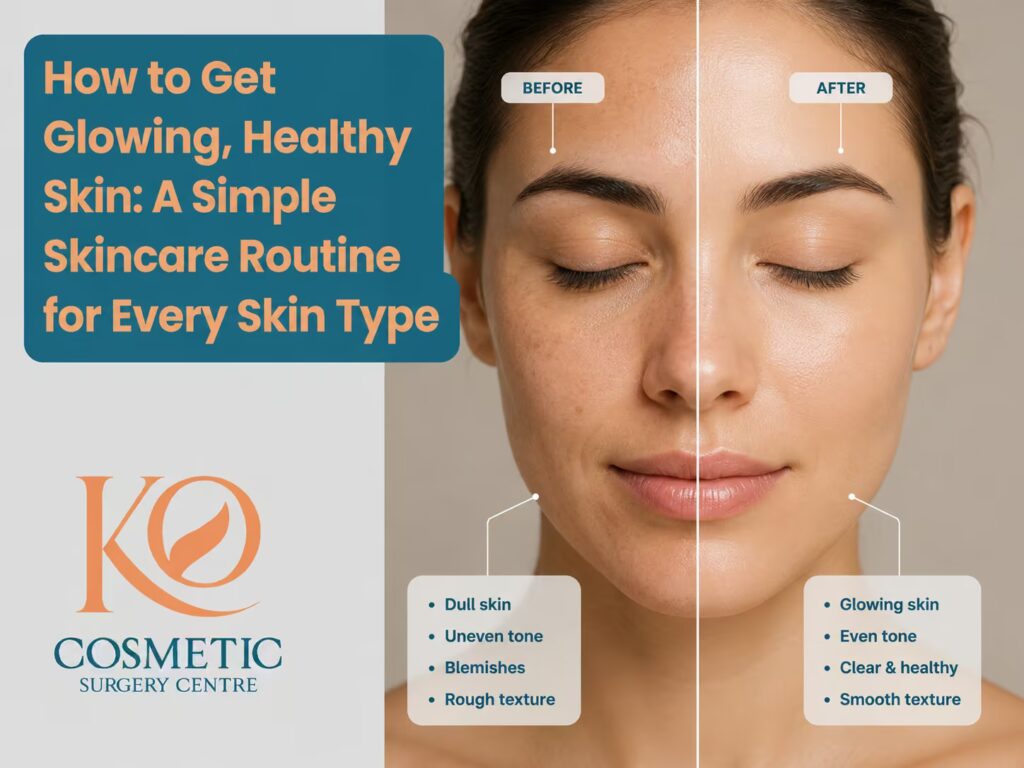
Have you ever looked at a film actress and wondered, “How does her skin always look so smooth, bright, and glowing?” While professional makeup, lighting, photography, treatments, and filters can all enhance appearance, healthy-looking skin also comes from something much simpler: consistent skincare and the right products for your skin type.
You do not need a complicated 10-step routine to achieve healthier, more radiant-looking skin. In most cases, a simple routine followed consistently can make a significant difference.
The key is to understand your skin type, your skin concerns, the right active ingredients, and the correct order of application.
This guide explains how to build a practical morning and night skincare routine for dry, oily, combination, acne-prone, sensitive, mature, or pigmented skin.
What Does “Glowing Skin” Really Mean?
Glowing skin does not necessarily mean perfectly fair, poreless, or completely flawless skin.
Healthy-looking skin generally appears hydrated, smooth, even-toned, and well cared for. Your natural skin tone does not need to change for your skin to look beautiful.
Factors such as dehydration, excessive oil, sun exposure, acne, pigmentation, uneven texture, and irritation can make the skin appear dull. A suitable skincare routine can help address these concerns gradually.
The most important word here is consistency.
Using several products for a few days and then stopping is unlikely to produce lasting results. Skincare generally requires regular use and patience.
The Basic Skincare Routine
A good routine does not have to be complicated.
Morning Routine
Cleanser → Moisturizer → Sunscreen
Night Routine
Cleanser → Serum or Treatment → Moisturizer
These three basic steps in the morning and evening can form the foundation of your skincare routine.
Let’s understand each step.
Step 1: Cleanser
The first step is cleansing your skin.
A cleanser helps remove dirt, excess oil, sweat, impurities, makeup, and sunscreen residue from the skin.
However, cleansing does not mean your face needs to feel extremely tight or dry afterward. A cleanser that is too harsh for your skin type may cause dryness and irritation.
Choose a gentle cleanser according to your skin’s needs.
For oily skin
A cleanser that helps remove excess oil without excessively drying the skin may be suitable.
For dry skin
A gentle, hydrating cleanser may be more comfortable.
For acne-prone skin
Products containing ingredients such as salicylic acid may help some people manage excess oil and clogged pores.
If your skin becomes irritated, excessively dry, or uncomfortable, reconsider the product you’re using.
Step 2: Moisturizer
Many people with oily or acne-prone skin think they should avoid moisturizer.
That is not necessarily true.
Moisturizing helps support the skin barrier and maintain hydration. Even oily skin can become dehydrated.
The important thing is choosing a moisturizer appropriate for your skin type.
Dry Skin
Look for moisturizing ingredients such as:
- Hyaluronic acid – helps attract and retain moisture.
- Ceramides – support the skin barrier and help reduce moisture loss.
- Lactic acid – can provide gentle exfoliation in suitable formulations.
Oily or Combination Skin
A lightweight, non-comedogenic moisturizer may be more comfortable.
Sensitive Skin
A simple moisturizer with fewer potentially irritating ingredients may be preferable.
Step 3: Sunscreen – The Most Important Morning Step
If you want healthier and more even-looking skin, do not skip sunscreen during the daytime.
Sun exposure can contribute to tanning, pigmentation, uneven skin tone, premature visible skin ageing, and other forms of sun damage.
Choose a broad-spectrum sunscreen with SPF 30 or higher, and apply enough to adequately cover exposed skin.
Sunscreen should be the final step of your morning skincare routine before makeup, if makeup is being used.
Remember that sunscreen is not a one-time application for the entire day. Depending on your exposure and activities, reapplication may be necessary.
If you are spending significant time outdoors, sweating, or swimming, follow the product’s instructions regarding reapplication.
What Should You Use at Night?
Your nighttime routine can focus more on cleansing, hydration, and addressing specific skin concerns.
Night Routine
Cleanser → Serum/Treatment → Moisturizer
If you have been wearing makeup or sunscreen during the day, make sure it is properly removed before cleansing.
After cleansing, you can use a serum or treatment selected according to your specific concern.
But remember: more active ingredients do not automatically mean better results.
Using too many strong ingredients together can irritate your skin.
Choose Active Ingredients According to Your Skin Concern
One of the most important parts of skincare is choosing an ingredient that matches your concern.
1. Sensitive Skin – Niacinamide
If your skin is prone to redness, irritation, or sensitivity, a gentle routine is especially important.
Niacinamide is a commonly used skincare ingredient that can support the skin barrier and help with concerns such as excess oil and uneven appearance.
Start with a suitable formulation and avoid introducing several new active ingredients at the same time.
If your skin reacts easily, simplicity is often better.
2. Uneven Skin Texture – Glycolic Acid
If your main concern is roughness, uneven texture, or dull-looking skin, glycolic acid may be useful.
Glycolic acid is an alpha hydroxy acid (AHA) that exfoliates the surface of the skin.
However, exfoliating acids can irritate the skin if used too frequently or incorrectly.
Start gradually and always use sunscreen during the day.
3. Dark Spots and Hyperpigmentation – Vitamin C
For dull-looking skin and uneven pigmentation, vitamin C is a popular ingredient.
It is an antioxidant that can help protect skin from environmental oxidative stress and may help improve the appearance of uneven skin tone over time.
However, pigmentation can have many causes, and stubborn or persistent pigmentation may require professional assessment.
4. Oily or Acne-Prone Skin – Salicylic Acid
If you have oily skin, clogged pores, blackheads, or acne-prone skin, salicylic acid may be helpful.
Salicylic acid is a beta hydroxy acid (BHA) that can penetrate into pores and help remove excess oil and dead skin cells.
Another ingredient commonly used for acne is benzoyl peroxide, which can help reduce acne-causing bacteria and inflammation.
If you have persistent, painful, severe, or scarring acne, it is better to consult a dermatologist rather than relying only on cosmetic skincare products.
5. Melasma and Pigmentation – Tranexamic Acid
Melasma is a type of pigmentation that often appears as brown or darker patches, particularly on areas such as the cheeks, forehead, and upper lip.
Tranexamic acid is one ingredient used in some skincare formulations targeting pigmentation.
However, melasma can be persistent and may require a combination of sun protection, topical treatments, and professional care.
A dermatologist can help determine the cause of pigmentation and recommend an appropriate treatment plan.
6. Fine Lines – Retinol
If your concern is fine lines, uneven texture, or visible signs of skin ageing, retinol may be considered.
Retinol is a vitamin A derivative commonly used in skincare for improving skin renewal and addressing signs of ageing.
However, retinoids can cause dryness, peeling, or irritation, particularly when you first start using them.
Introduce retinol gradually and follow professional advice if you have sensitive skin or existing skin conditions.
Retinoids are generally used at night, and daytime sun protection remains important.
7. Dehydrated or Dull Skin – Hyaluronic Acid
If your skin feels dry, tight, or dehydrated, hyaluronic acid can be a useful hydrating ingredient.
It helps attract and retain water in the skin.
For best results, apply a suitable hydrating product and follow with a moisturizer to help support the skin barrier.
Remember that hydration is not only about applying products. Adequate fluid intake and a healthy lifestyle also contribute to overall wellbeing.
What About Different Skin Types?
Your skincare routine should be customized according to your skin type.
Dry Skin
Focus on:
Hyaluronic Acid + Ceramides + Moisturizer + Sunscreen
Avoid excessive cleansing and over-exfoliation.
Oily Skin
Focus on:
Gentle Cleanser + Salicylic Acid when appropriate + Lightweight Moisturizer + Sunscreen
The goal is to control excess oil without damaging the skin barrier.
Combination Skin
Combination skin may have oily areas, particularly around the T-zone, while other areas feel normal or dry.
A balanced routine is important. You may need different product textures for different areas of your face.
Acne-Prone Skin
Ingredients such as salicylic acid, benzoyl peroxide, and retinoids can be useful for acne management, depending on the individual.
Do not introduce all of them at once.
Mature Skin
A routine may focus on hydration, sun protection, and ingredients such as retinoids, vitamin C, and peptides, depending on individual needs and tolerance.
Normal Skin
Even if you do not have major skin concerns, you still need the basics:
Cleanser → Moisturizer → Sunscreen
You can add targeted products only when necessary.
How Much Skincare Product Should You Use?
Using the right amount matters.
You don’t necessarily need a large amount of every product.
A general guide is:
- Cleanser: Enough to gently cleanse the face.
- Serum: Usually a few drops, depending on the product instructions.
- Eye cream: A small amount is generally sufficient.
- Moisturizer: Enough to comfortably cover the face.
- Sunscreen: Apply an adequate amount to cover all exposed skin.
For sunscreen, using too little can significantly reduce the protection you actually receive.
Always follow the instructions provided with the specific product.
Don’t Start Everything at Once
This is one of the biggest skincare mistakes people make.
You see several ingredients recommended online and decide to use:
Vitamin C + Glycolic Acid + Salicylic Acid + Retinol + Niacinamide
all at the same time.
That can be too much for your skin.
Instead, introduce products gradually.
If you develop irritation, it becomes much easier to identify which product may have caused it.
A simple routine that you follow consistently is often better than a complicated routine that causes irritation.
Consistency Is More Important Than Expensive Products
You do not need the most expensive skincare products to have healthy-looking skin.
A basic routine with suitable products can be more useful than purchasing numerous products simply because they are expensive or popular.
Focus on:
The right product + the right ingredient + the right amount + consistency.
Give your skincare routine enough time before deciding whether it is working.
When Should You See a Dermatologist?
Skincare products are useful for many everyday concerns, but they cannot replace professional evaluation when you have a significant skin problem.
Consider consulting a dermatologist if you have:
- Persistent or severe acne
- Painful or cystic acne
- Acne scars
- Persistent pigmentation
- Melasma
- Severe sensitivity or irritation
- Sudden changes in your skin
- A rash that does not improve
- Significant hair or skin-related concerns
A dermatologist can assess your skin and recommend treatments based on your individual condition.